

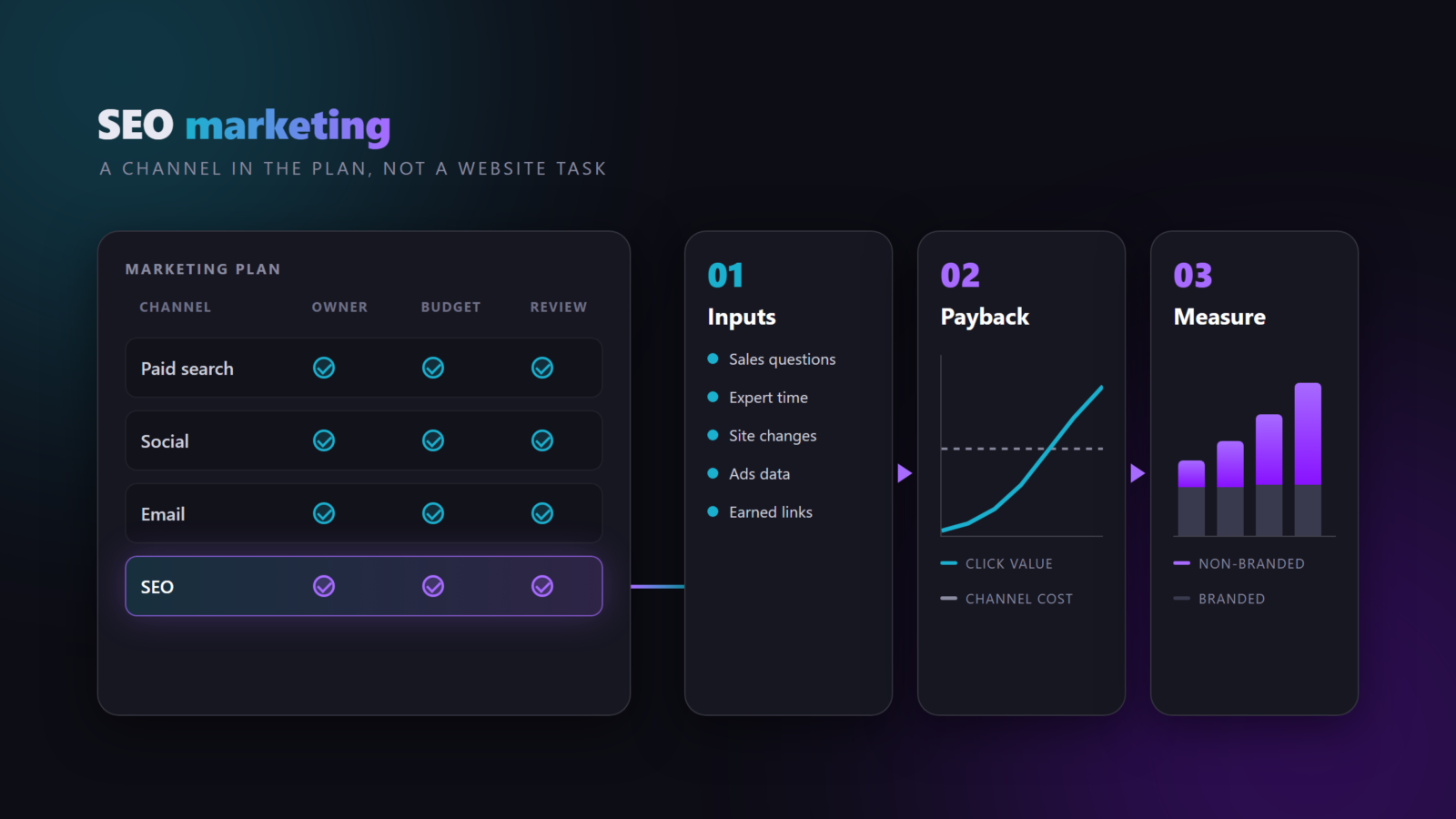
SEO marketing is the practice of running organic search as a channel in your marketing plan, with an owner, a budget line, inputs from the rest of the business and its own numbers, rather than as a one-off job done to the website.
In our experience, when a company says SEO did not work, the technique is rarely what went wrong. It was run as a project, and projects end.
SEO is a channel, not a website task
The usual story: the site gets rebuilt, someone is paid to “optimise” it, the titles and meta descriptions are tidied, and then nothing happens for a year, because nobody owns what comes next. Search rewards the sites that keep answering their buyers’ questions better than the alternatives, which is ongoing work, so a one-off fix fades as quietly as it arrived.
Compare that with how you run paid search. There is a person responsible for it, a monthly budget, a report somebody reads and decisions that follow from the report. Give SEO the same four things and it starts behaving like a channel: you know what went in, you know what came out, and you can argue about whether the ratio is right.
A channel you can argue about is a channel you can improve.
What the channel needs from the rest of the business
A specialist can handle the technical work alone, but the parts that decide whether SEO brings leads sit with you, and they are the inputs most plans forget to budget for.
Start with the questions your sales team hears every week. Those questions are what your buyers type into Google before they call anyone, which makes them the raw material for pages that attract people already halfway to a decision. A monthly half-hour with whoever answers the phone is worth more than another keyword export, because it tells you which questions come from buyers and which from the merely curious.
Then there is expertise. Google Search Central’s guidance on helpful content asks whether a page shows first-hand expertise and whether it was written or reviewed by someone who demonstrably knows the topic, so plan on thirty minutes of an expert’s time per piece. Without it, you get articles that read like everyone else’s.
Two more inputs are easy to miss. The site has to be changeable in days rather than quarters, since an SEO plan that waits three months for every developer ticket is not really a plan. And authority has to be earned through work other sites want to cite, which is slower than buying links and the only kind that lasts, as we set out in which backlinks actually move rankings.
When to expect it to pay back
Nobody can give you a date, and you should be wary of anyone who does. Google Search Central’s page on hiring an SEO says plainly that no one can guarantee a #1 ranking, and suggests asking for realistic estimates of improvement instead.
What you can agree on in advance is how payback will be judged. The simplest method values organic clicks at what the same clicks would cost you in Google Ads. As an illustration with round numbers: if the pages you worked on bring 200 non-branded clicks a month on queries that cost €3 a click in the auction, that is €600 a month of traffic you no longer rent, and it keeps accruing for as long as those pages hold their positions. Set that against what the channel costs you and you have a payback line you can track month by month.
Expect the signals to arrive in order. Impressions usually move first, since a page tends to appear for a query, low down, before it ranks well; clicks follow; enquiries come last. How much budget SEO should take from paid search while you wait is a separate decision, covered in how SEO and paid search split one budget.
Measure the non-branded half separately
Most SEO reports show total organic traffic rising and stop there, which hides the one distinction that tells you whether the work is paying. People who search for your company name were going to find you anyway, whereas people who search for the problem you solve, without knowing you exist, are what SEO marketing actually adds.
Google Search Console, Google’s free reporting tool for site owners, now separates the two. Its branded queries filter, announced in November 2025 and available to all eligible sites since March 2026, splits the Performance report into branded and non-branded queries, using an AI-assisted classification that also catches misspellings of your name. Google notes that branded queries tend to rank higher and earn higher click-through rates, which is exactly why leaving them mixed in flatters the report.
So read the non-branded line on its own. If it stays flat while the total grows, your brand is doing the work, not your SEO.
The numbers worth a monthly report
A useful report fits on one page and runs from early signals to money:
- Non-branded impressions and clicks for the pages you actually worked on, since site-wide totals bury them.
- How many of those pages sit in the top ten for their target query, the leading indicator closest to traffic.
- Impressions in AI features. Search Console’s generative AI performance reports, launched in June 2026 and open to all websites since 31 August 2026, show how often your URLs appeared in AI Overviews and AI Mode, Google’s generated answers.
- Organic enquiries, counted from the form and the phone rather than estimated.
- How many of those enquiries sales accepted as qualified, taken from your CRM, because that is the number the whole channel exists to move.
Two familiar numbers can leave the report. Total sessions mixes buyers with job seekers and bots, and an average position across the whole site averages your best page with your worst, so neither tells you what to do next. Then give whoever runs the channel read access to Search Console, as that same Google page suggests, so every figure can be checked against the source.
Where SEO sits next to your other channels
SEO marketing works best when it trades with the rest of the plan instead of running beside it. Paid search can show within days whether a query brings enquiries before you commit months of content to it, which is one reason it belongs in the same conversation as performance marketing. Going the other way, a good article answers the question your sales team keeps answering by email, gives your social channels something worth sharing, and keeps working long after the campaign that launched it has ended.
That exchange is the real case for treating search engine optimization marketing as a channel, since each piece of work feeds two or three others in a way a one-off website task never does. If you want a second view on how your SEO is set up and measured today, our SEO services page explains how we work and how to reach us.
FAQ
Is SEO marketing the same as search engine marketing?
Not quite. Search engine marketing covers both routes onto the results page, paid ads and organic rankings, while SEO marketing is the organic half run as a channel of its own. They work best together, because paid search shows quickly which queries convert and SEO lowers what you pay for them over time.
How much of a marketing budget should go to SEO?
No fixed share suits every business. It depends on what clicks cost in your market, how soon you need enquiries, and what you already rank for. Expensive clicks and a longer horizon pull budget towards SEO, while an urgent pipeline and a site starting from zero usually mean paid search carries the early load.
How long does SEO marketing take to bring in leads?
Nobody can promise a date, and Google’s own guidance says no one can guarantee a top ranking. Expect impressions to move first, then clicks, then enquiries. How long each step takes depends on the competition for your queries, the authority your site already has, and how consistently new work gets published.
Does SEO marketing work in a small B2B market?
It often works better than the volumes suggest. A query searched twenty times a month still matters when one new client is worth a great deal to you, and you can judge the competition by reading what ranks today. The key is choosing the queries buyers use, not the ones with the biggest numbers.
What should a monthly SEO report show you?
A useful one shows non-branded clicks and impressions for the pages being worked on, how many of those pages rank in the top ten, impressions in AI Overviews and AI Mode, organic enquiries, and how many of them sales accepted as qualified. Total sessions and a site-wide average position can safely be left out.