
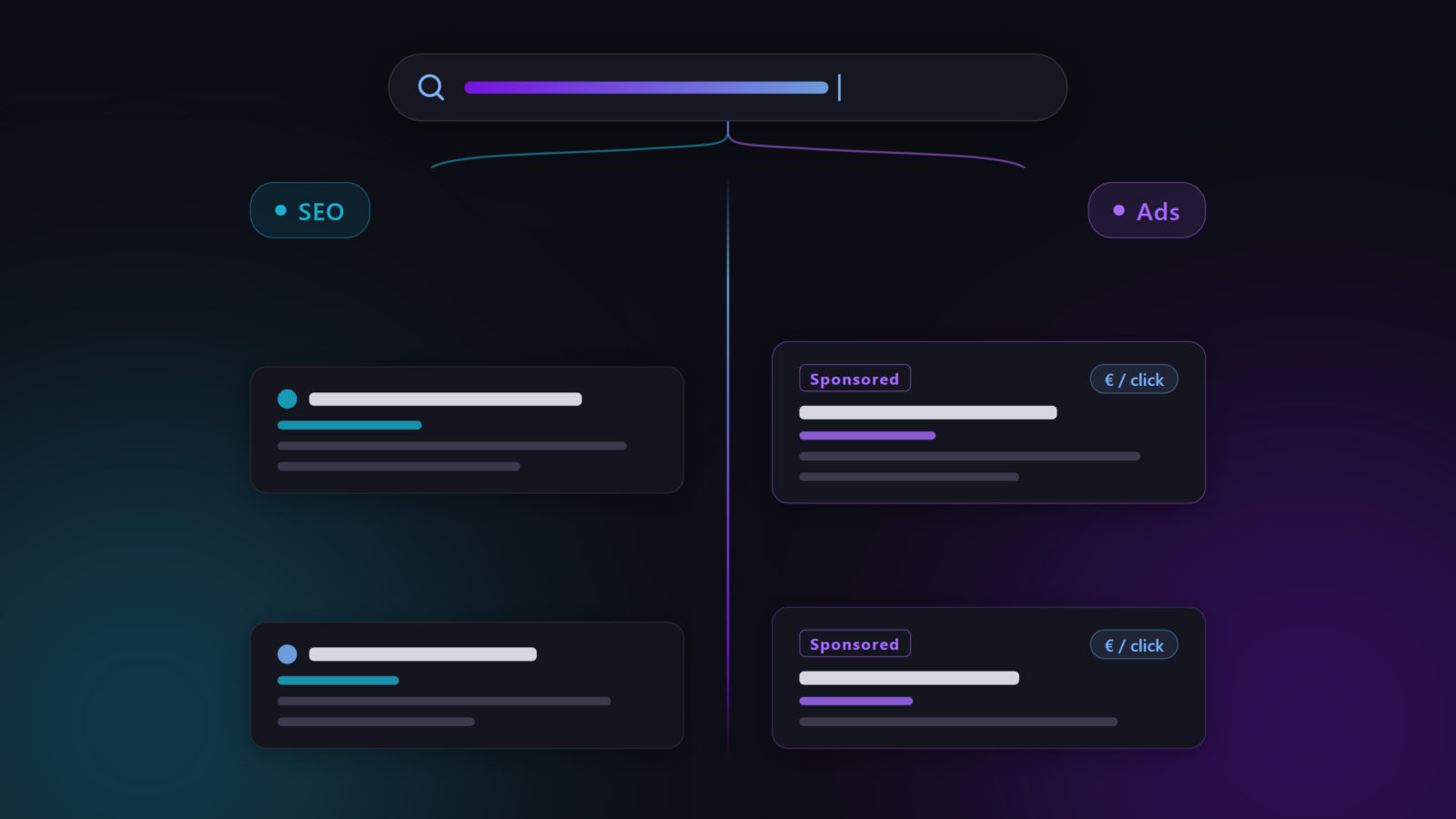
Search engine marketing (SEM) is the work of being present on a search results page through both routes at once: the organic rankings you earn through SEO, and the paid ads you buy through platforms like Google Ads. Some people use the term for paid search alone, but in practice the two run on the same page, chase the same buyer, and draw from the same budget — which is why treating them as one discipline is the only version of the term that actually helps you decide anything. And the decision that matters is not “which channel is better”, because that argument has no winner. It is how one budget gets split between them, and when the split should change.
One results page, two ways to be on it
Type a commercial query into Google and look at what comes back: ads at the top, an AI Overview or a map pack somewhere in the middle, organic results underneath — one page, assembled from things companies paid for and things they earned. Your buyer does not separate them the way marketing teams do, since they scan the page as a whole and click whatever looks most like an answer.
That shared page is why the two channels feed each other when they are run together. Paid search tells you, within days, which exact queries turn into enquiries and which just burn clicks — months faster than rankings could, and exactly what decides which pages deserve SEO effort. Organic works the return leg: every click a ranking page brings in is a click the auction no longer bills you for, which quietly lowers what the whole system pays per lead.
Run them from separate silos and both halves of that exchange are lost.
When paid search earns the budget
Paid earns its share whenever speed matters more than cost per click — and that shows up in three situations in particular:
- The pipeline is thin right now. A campaign can be live tomorrow and generating enquiries this week, which no SEO plan can honestly offer — “in six months” is not an answer when this quarter needs revenue.
- You have something to learn. Before committing months of content work to a topic, a small Google Ads test tells you whether the query converts at all and which message makes it convert — in days, not seasons.
- The demand is seasonal. When the buying window opens and closes within weeks, only a channel you can switch on at full strength is worth the money.
Paying for a few hundred clicks to find out a keyword is a dead end is cheap; discovering the same thing after half a year of content production is not.
The limitation is structural, though. Paid traffic stops the moment the spending stops. Nothing accumulates.
When SEO earns it
SEO earns the budget through arithmetic that gets stronger the more expensive your market’s clicks are. When the auction prices a click at six or twelve euros — and in some service markets it does — a page that ranks organically for that query is producing value month after month while being billed for none of it. The work you fund once keeps paying; the ad budget buys the same click again every time.
That compounding is also why quality matters more than volume here: rankings built on thin content and cheap links do not hold — we covered that in which backlinks actually move rankings and which are liabilities. Building pages and authority that last is what SEO services exist to do, and it is slower than anyone wants — typically months before real movement, the honest price of traffic you stop paying for per click.
How to decide the split
This is where search engine marketing stops being theory: the split is a judgment call, but a judgment with criteria, and each one exists for a reason.
- What a click costs in your market. The more expensive the click, the stronger the case for SEO investment on that query, because expensive clicks are exactly the ones worth earning instead of renting.
- Your time horizon. If revenue is needed this quarter, paid takes the larger share, since it is the only channel that converts budget into pipeline this month. If you can carry a longer view, shift weight toward organic, because that is where the cost curve bends downward over time.
- What you already rank for. Defending and extending positions you hold is far cheaper than conquering new ones, so existing rankings pull budget toward SEO, while starting from zero in a competitive space often means paid carries the early load.
- The results page itself. If ads, marketplaces and heavyweight publishers occupy everything above the fold for your money queries, the organic slot you are imagining may not really exist — and knowing that before you spend is the whole point of looking.
What AI Overviews change about the split
Most search engine marketing playbooks were written before AI Overviews — the generated answers Google now places above the results — and it shows. When Google answers a question directly on the page, the informational click that used to reward a ranking article often never happens: Pew Research Center measured it in 2025, finding that searches showing an AI summary ended in a click on a result roughly half as often as searches without one.
Which changes what the split means. The useful division is no longer “SEO gets X, ads get Y” but a query-by-query decision: commercial queries still reward both channels, while purely informational ones increasingly reward being cited as the source rather than being visited. Budgeting as if every query still delivers a click is how money quietly disappears now.
FAQ
Is SEM just paid ads, or does it include SEO?
Some textbooks reserve SEM for paid search only. The useful definition is the wide one — paid and organic managed together — because the two share a results page, a buyer, and a budget, and every real decision you make involves both at once.
What is the difference between SEO and SEM?
SEO is one component of search engine marketing: the work of earning organic rankings. SEM is the umbrella over that work plus paid search advertising, covering how the two are balanced against each other — one budget, two routes onto the same results page.
Should a small budget go to SEO or Google Ads first?
Decide by urgency. If you need enquiries within weeks, start with ads, because nothing organic moves that fast. If you can wait, put the first budget into SEO on the queries with the highest click prices, and use a small ad test to confirm those queries convert before the content work begins.
How long does SEO take to pay back compared with ads?
Ads return data and enquiries within days. SEO typically needs several months before positions and traffic move meaningfully — the range depends on competition, your starting authority, and how consistently the work ships. The reward for the wait is traffic that no longer bills you per click.
Do AI Overviews make search ads more important?
For informational queries they often reduce organic clicks, which strengthens the case for paid presence on the queries that still convert. But they also raise the value of being the cited source, so the sensible response is rebalancing by query type — not abandoning either channel.
Working out where the split should land for your business is a conversation, not a formula. If you want a second pair of eyes on how your search budget is divided, get in touch and we will look at it with you.