
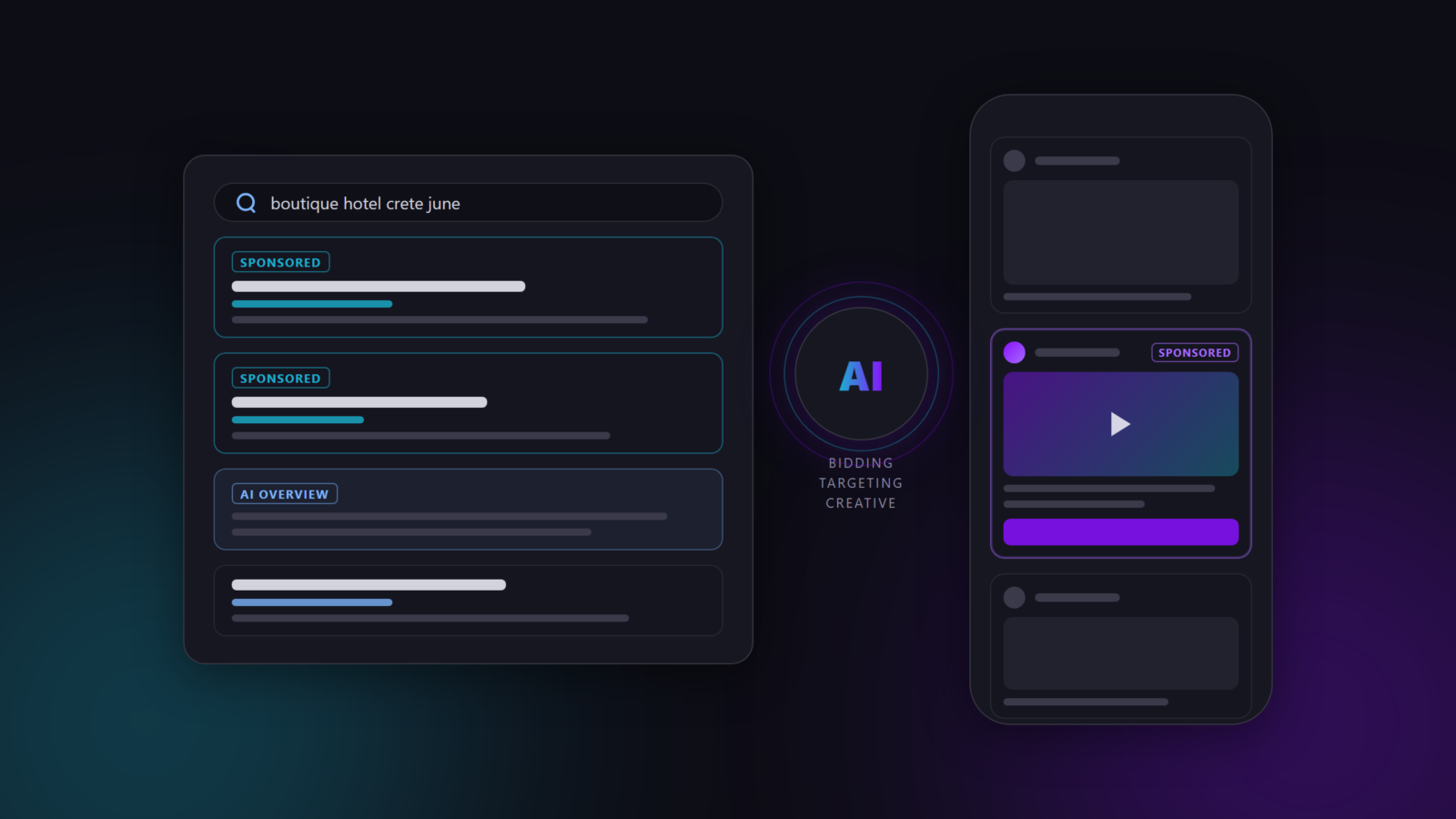
Performance marketing is advertising you pay for by the outcome: a lead, a booking, a sale, so you know within days what a euro brought back instead of hoping a campaign “raised awareness”. What changed recently is that Google, Meta and TikTok now run the bidding, the targeting and much of the creative themselves, which should make things easier. It does the opposite. The mechanics got automated, so the result depends on what a human feeds the machine.
What performance marketing actually pays for
A billboard sells exposure; a performance campaign sells the customer’s action itself, which is why it is run on cost per lead, cost per acquisition and return on ad spend rather than reach. If the action is not measured, it is not performance advertising. The market agrees: the Interactive Advertising Bureau (IAB), the industry’s trade body, described the 2025 US market in its April 2026 report with PwC as one that “has reoriented around performance channels”. Budget follows proof.
Why advertising stopped being optional
WPP Media, the WPP group’s media arm, puts global advertising revenue at $1.3 trillion this year, up 8.9%, while the advertising group dentsu has digital at roughly 69% of all ad spend. IAB Europe measured European digital advertising at €131 billion in 2025, up 10.5%, with social alone growing 19.2% to €35.5 billion, and the Greek market reached €364 million in the latest IAB Hellas benchmark, up 12.8% in a year.
Every auction is getting more crowded. Staying out of paid advertising is not a neutral position; it hands the slot to whoever else wanted it, and your buyer never sees the businesses that were not there.
Google Ads and social ads do two different jobs
The two platforms answer two different questions. Search advertising captures demand that already exists: someone in Heraklion types “boutique hotel Crete June” and a performance marketing campaign meets them at the moment of intent. Social advertising creates demand that did not exist yet: nobody was searching for your product at 11pm on Instagram, and a ten-second video found them anyway.
US social ad revenue grew 32.6% in 2025, three times the pace of search, according to the IAB and PwC. WordStream by LocaliQ’s 2026 benchmarks put the average Google search click at $5.42 and the average lead at $66.69, while a Meta lead campaign averages $27.66 per lead. Cheaper is not better, though: a search lead is already looking for you, whereas a social lead is often merely curious. Which is why the answer for most businesses is both, in sequence: search until existing demand is saturated, then paid social campaigns to create more of it. How that budget sits next to SEO is a question we covered separately.
What AI inside the platforms now does — and what it does not
In April, Google moved AI Max for Search out of beta — the layer that expands targeting and ad text on its own — and is retiring Dynamic Search Ads by February 2027. Google’s own data says the full AI Max feature set brings about 7% more conversions at a similar cost, and in May it announced ad formats for AI Mode, its conversational search.
Meta is moving faster still. On its July earnings call it said Advantage+, its end-to-end automation suite, had passed a $75 billion annual revenue run rate. Its new Generative Recommender and GEM models lifted clicks 8.3% and conversions 15.7% on Facebook — Meta’s figures, not independently verified. Mark Zuckerberg has said the goal is a business entering a credit card and a goal and the AI doing the rest, reportedly by the end of this year. TikTok’s Smart+ claims a 29% lower cost per acquisition for catalogue ads than manual campaigns, from its own testing.
Now the other half. Media buyers interviewed by Marketing Brew, the marketing trade newsletter, said in April that Meta “isn’t ready for full automation”. The AI optimises toward whatever you defined as success and whatever data you gave it. It does not know that half your “leads” are students asking for a quote, that August is dead for your business, or that the conversion you told it to chase is a page view. The levers moved from bids and keywords to inputs.
The gap between an amateur and an expert is now the inputs
An expert and a beginner now differ in the setup the algorithm inherits, and a bad setup no longer looks bad, because the machine will spend the budget cheerfully and report activity either way.
A conversion defined as “visited the contact page” instead of “submitted a qualified enquiry” trains the system to find people who browse rather than people who buy. Broad targeting without exclusions — no negative keywords, no placement list, no geography trimmed — lets it chase cheap clicks in places you will never sell. On Meta, marketers produce 300 variants of one idea when Andromeda, its ad-retrieval system, rewards a handful of genuinely distinct concepts.
The cost of getting this wrong has roughly doubled: LocaliQ’s average search click was $2.32 in 2016 and $5.42 in 2026, and 38% of buyers in the IAB’s 2026 Outlook Study call understanding generative AI a major challenge, up 14 points in two years. Being able to open Ads Manager was never the skill. Knowing what to tell it is.
What you gain when it is run well
Performance marketing gives you the one thing most marketing cannot: a cost per lead you can plan a business around. You learn within days which offer, audience and message convert, and you can turn the budget up when the pipeline is thin and down when the season closes. The learning compounds too, because the search terms that convert tell your SEO what to rank for. None of that happens unless the measurement underneath is right, which is why our Mar-Tech and measurement setup work treats conversion tracking, GA4 and server-side data as part of the campaign.
Five questions to ask before anyone runs your ads
Whether you hire an agency, a freelancer or your nephew, these separate someone who understands performance marketing from someone who can find the “publish” button:
- What counts as a conversion, and how is it verified? If the answer is a page view, the algorithm is optimising for the wrong thing from day one.
- What are you excluding? Negative keywords, placements, regions and audiences you will never sell to are where budget quietly disappears.
- How is creative tested, and how many distinct concepts run at once? The platforms now reward variety of ideas, not variations of one.
- How will you report results, and against what baseline? Platform dashboards claim credit generously; ask how incremental leads are separated from the rest.
- What happens when the platform switches on a new AI feature by default? Somebody needs to notice, test it and decide, because the platform will not ask.
If the person in front of you cannot answer these without hesitating, the campaign will run, the budget will be spent, and the report will look fine. The results will not.
FAQ
What is the difference between performance marketing and digital marketing?
Digital marketing is everything you do online — SEO, content, email, social presence, ads. Performance marketing is the subset you pay for by measured outcome: leads, sales, bookings. Every performance campaign is digital marketing, whereas most digital marketing cannot be priced per result.
Is Google Ads or social media advertising better for a small business?
It depends on whether demand already exists. If people search for what you sell, Google Ads meets them at the moment of intent and usually pays back first; if not, social advertising creates the demand. Most businesses end up running both.
Can AI run my ad campaigns on its own?
It runs the mechanics — bidding, targeting, placement, increasingly creative — and does it well. It cannot decide what a good lead is, which product is worth chasing, or when the platform’s own defaults are wrong for you. Whoever sets those inputs fills that gap.
How much should I spend on performance ads?
Work backwards: decide what a lead is worth to you and what cost per lead you can live with, then fund enough clicks to get a reliable read, usually four to six weeks of data. What that costs depends on your market and your competition.
How quickly does performance marketing show results?
Data arrives within days, a dependable read on cost per lead takes a few weeks, and the improvement compounds from there as the account learns. Anyone promising a fixed result by a fixed date is describing a promise, not a campaign.
If you want a second pair of eyes on how your campaigns are set up — what they count, what they exclude, what has been switched on without you knowing — get in touch and we will walk through the five questions on your own account.