

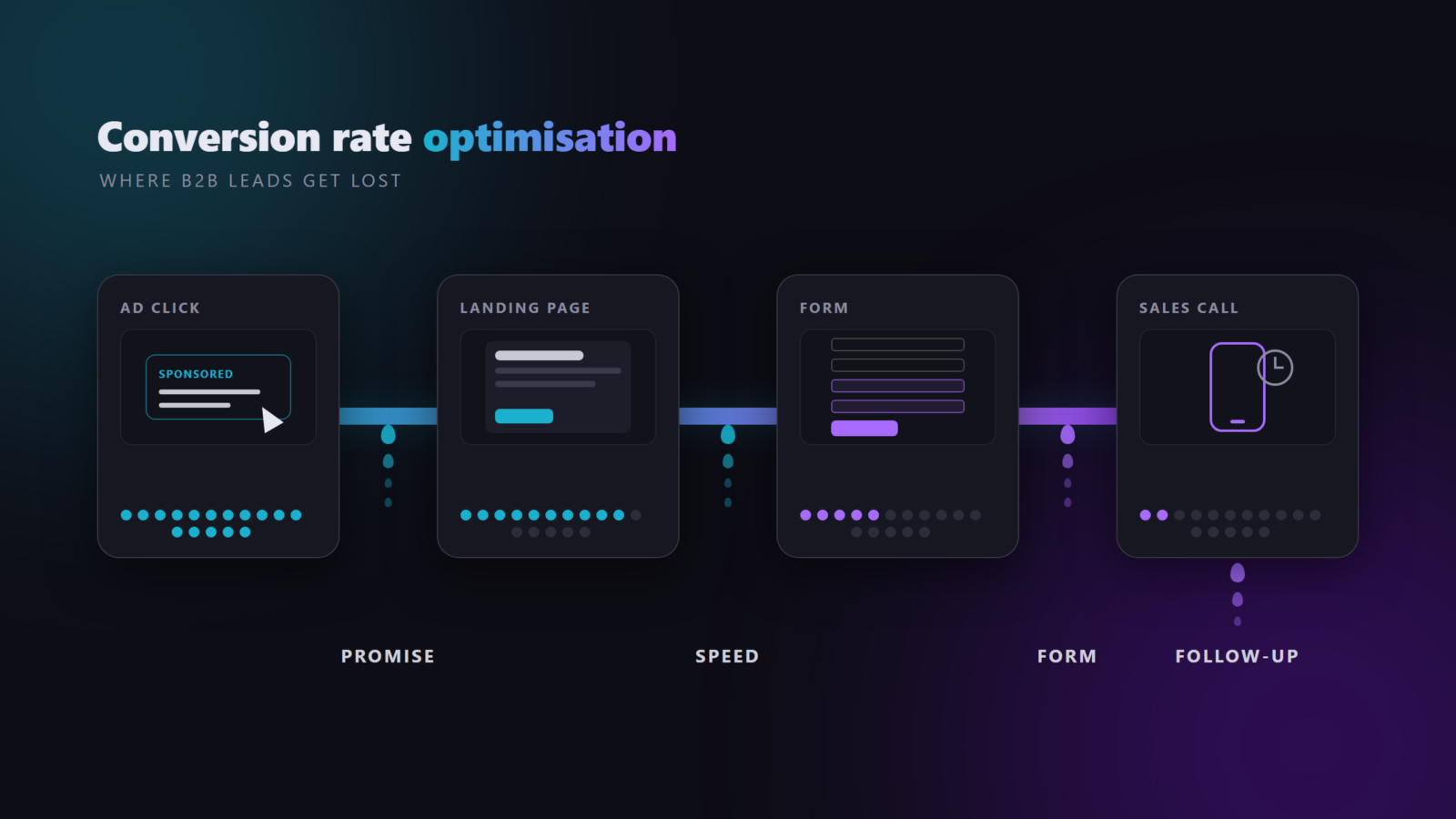
Conversion rate optimisation (CRO) for a B2B business is the work of getting more qualified enquiries out of the traffic you already pay for, by fixing the points between the ad click and the sales call where people drop out. For most companies that means the page, the form and the follow-up.
Most guides to CRO are written for online shops, where the job ends at the checkout. In B2B the form is where the real work starts, and a lead that is never called back costs as much as one that never arrived.
A conversion rate means little until you know what converted
The first question is not “is my rate good” but “what is being counted”, since a form fill from a student, a supplier pitching you or a competitor checking your prices all register as conversions. Unbounce, the landing-page platform, puts the median conversion rate at 6.6% across industries and 6.1% for professional services in its 2024 benchmark of 41,000 pages. LocaliQ, the ad-services company behind WordStream, puts the 2026 Google Ads average at 8.18%, and 4.85% for business services.
So is 2.5% good? It can be, if most of those enquiries are buyers, whereas 9% made up of job applicants is worse than useless because it teaches your ad account to find more of them. Before you change anything, agree with sales what a qualified lead is and count those separately. That number, not the raw rate, is what conversion rate optimisation is meant to move.
The page breaks the promise the ad made
The most common leak is also the simplest: the ad promises one thing and the page talks about something else. Someone clicks on “energy audits for factories” and lands on a homepage with the company’s history and six services, left to work out alone whether they are in the right place. Most will not bother.
Each intent you advertise for deserves a page that repeats the promise in its first line, says who it is for, and shows the next step without scrolling. You do not need a page for every keyword, but you do need one for every distinct reason someone would contact you.
A slow page loses people before they read
In Milliseconds Make Millions, a 2020 study Deloitte prepared for Google on European and US brands, a 0.1-second improvement in mobile speed lifted the share of lead-generation visitors who progressed to the form page by up to 21.6%. The visitor who leaves during a slow load never sees your offer or your form.
Check the page on a mid-range phone over mobile data, not on the office laptop, because that is the slowest version of your page anyone will see. Heavy sliders, uncompressed images and forgotten tracking scripts are the usual causes, and fixing them is cheaper than a redesign. If the template itself is the problem, a site built for speed is worth more than another month of ad budget.
The form asks for too much, too early
A B2B form tends to grow by committee: sales wants the budget, marketing wants the industry, and the result is a questionnaire standing between a buyer and a conversation. Every field should earn its place by answering one question, which is whether sales needs it before the first call. Name, company, a way to reach the person and one line about the need is usually enough; the rest can be asked on the call.
Let people choose phone or email, because some buyers will not give a number to a stranger and others would rather talk than write. And treat the thank-you page as a page: tell people when they will hear from you and from whom, which costs nothing and cuts down the calls that go unanswered.
Most leads are lost after the form
This is the leak that no CRO checklist on page one of Google mentions, and in B2B it is often the largest. Researchers writing in Harvard Business Review audited 2,241 US companies and found that those who tried to contact a lead within an hour were nearly seven times as likely to qualify it as those who waited an hour longer. Against a wait of a day, the gap was more than 60 times. The average response time was 42 hours.
The study dates from 2011, and buyers have only become quicker at calling the next supplier since. If enquiries land in a shared inbox that someone checks after lunch, your conversion rate is being decided there and not on the page. A notification to the right person’s phone and a rule about who calls back within the hour will often do more than any redesign.
Why most B2B sites should not A/B test yet
Nearly every article ranking for conversion rate optimisation recommends A/B testing, and almost none mention that it needs traffic most B2B sites do not have. The standard sample-size calculation is unforgiving: at a 3% conversion rate, detecting a 20% relative improvement with 95% confidence and 80% power takes roughly 14,000 visitors per version. A page with 2,000 visits a month would need about fourteen months for one test, by which time the market has moved.
That does not mean guessing. Watch session recordings of people who reached the form and left, check which field they abandon, and read the notes from recent sales calls, because they tell you what the page failed to answer. Then make one change at a time and compare equal periods before and after, knowing that this is a reasonable read rather than a controlled test.
Tell the ad platforms which leads were real
Google and Meta optimise towards whatever you report as a conversion, so if every form fill counts the same, the algorithm will happily find you more of the cheap, unqualified ones. Automated bidding is only as good as the inputs you give it.
Enhanced conversions for leads, a Google Ads feature, lets you send back which enquiries became qualified or turned into customers, matched through hashed first-party data such as the email address from the form. It takes some tracking and automation work between your forms, your CRM and the ad account, but it turns your sales team’s judgement into a signal the platform uses every day.
Where to start with conversion rate optimisation
If you are starting from scratch, this is the order we would work in, because each step makes the next one measurable:
- Define a qualified lead with sales and count it separately from form fills.
- Fix response time: who gets notified, and who calls back within the hour.
- Match each ad’s promise to a page that keeps it in its first line.
- Make that page fast on a phone over mobile data.
- Cut the form down to what sales needs for the first call.
- Send qualified-lead data back to the ad platforms.
- Only then, if the traffic allows it, start testing.
If you would like a second pair of eyes on where your leads leak, that is the kind of work our performance marketing team does every week.
FAQ
What is a good conversion rate for a B2B landing page?
Unbounce’s benchmark puts the median at 6.1% for professional services pages and 6.6% across all industries. Treat that as context rather than a target: a lower rate with more qualified buyers beats a high rate full of unsuitable enquiries, so measure qualified leads alongside the raw rate.
Should I improve my conversion rate or buy more traffic first?
If you pay per click, fix conversion first. Doubling the share of visitors who enquire halves your cost per lead without spending another euro, whereas more traffic sent to a leaking page only multiplies the leak. Traffic becomes the priority once the page, the form and the follow-up are working.
How long does conversion rate optimisation take to show results?
Fixes such as faster follow-up or a shorter form can show within weeks, provided you compare equal periods with similar traffic. Larger changes need longer to read reliably. Anyone promising a fixed uplift by a fixed date is describing a hope, because the result depends on your market and your traffic.
How many fields should a B2B lead form have?
There is no right number, only a test for each field: does sales need it before the first call? For most businesses that means name, company, contact details and one line about the need. Anything else can be asked in the conversation, where it feels like help rather than an obstacle.
Can I do CRO without A/B testing?
Yes, and most B2B sites have to. Use session recordings, form drop-off data and notes from sales calls to find where people stall, then make one change at a time and compare equal periods before and after. It is less precise than a controlled test, but far better than guessing.