

Content marketing is the practice of publishing material your buyers find useful, such as articles, case studies and guides, on channels you own, so that they find you, trust you and get in touch when they are ready to buy. It brings enquiries when each piece answers a question a real buyer asks before a purchase.
Most explanations stop at the definition and a list of benefits, which is why so many company blogs are full and so few produce a lead. What decides whether it pays is who you write for, which formats you choose, how often you can publish without the quality dropping, and what you count as a result.
What separates content marketing from simply publishing
A company that posts news about itself is publishing, whereas a company that answers the questions its buyers type into Google before they call anyone is doing content marketing. The first starts from what the company wants to say and the second from what the buyer needs to know.
It also differs from advertising in who owns the attention. An ad rents a place in front of people for as long as you pay, while an article on your own site keeps working after the invoice is settled, because you own both the page and the audience it builds. The Content Marketing Institute (CMI), a research and training organisation for the field, surveyed 861 B2B marketers, most of them in North America, for its trends report published in November 2026. Owned media came first among the areas where they expect to invest most in 2027, named by 42%.
Ads bring demand this month. Content builds the demand you will not have to rent next year.
Why it suits a long B2B sale
When a purchase is large and several people have to agree on it, buyers do much of their reading before they speak to a supplier, and they remember the companies that helped them understand the problem. Useful content is how you take part in that reading without being in the room.
The same CMI research asked marketers what builds trust and credibility with an audience. The top answer, chosen by 64%, was consistently providing useful, practical information, followed by demonstrating industry expertise at 59% and showcasing customer stories and testimonials at 50%. Nothing on that list is about volume.
For an energy installer, a hotel or a software firm it comes to the same thing: say what you know, show that you have done it, and let a customer confirm it.
Which formats do which job
Formats are not interchangeable, and many plans fail because they pick one, usually blog posts, and expect it to do everything.
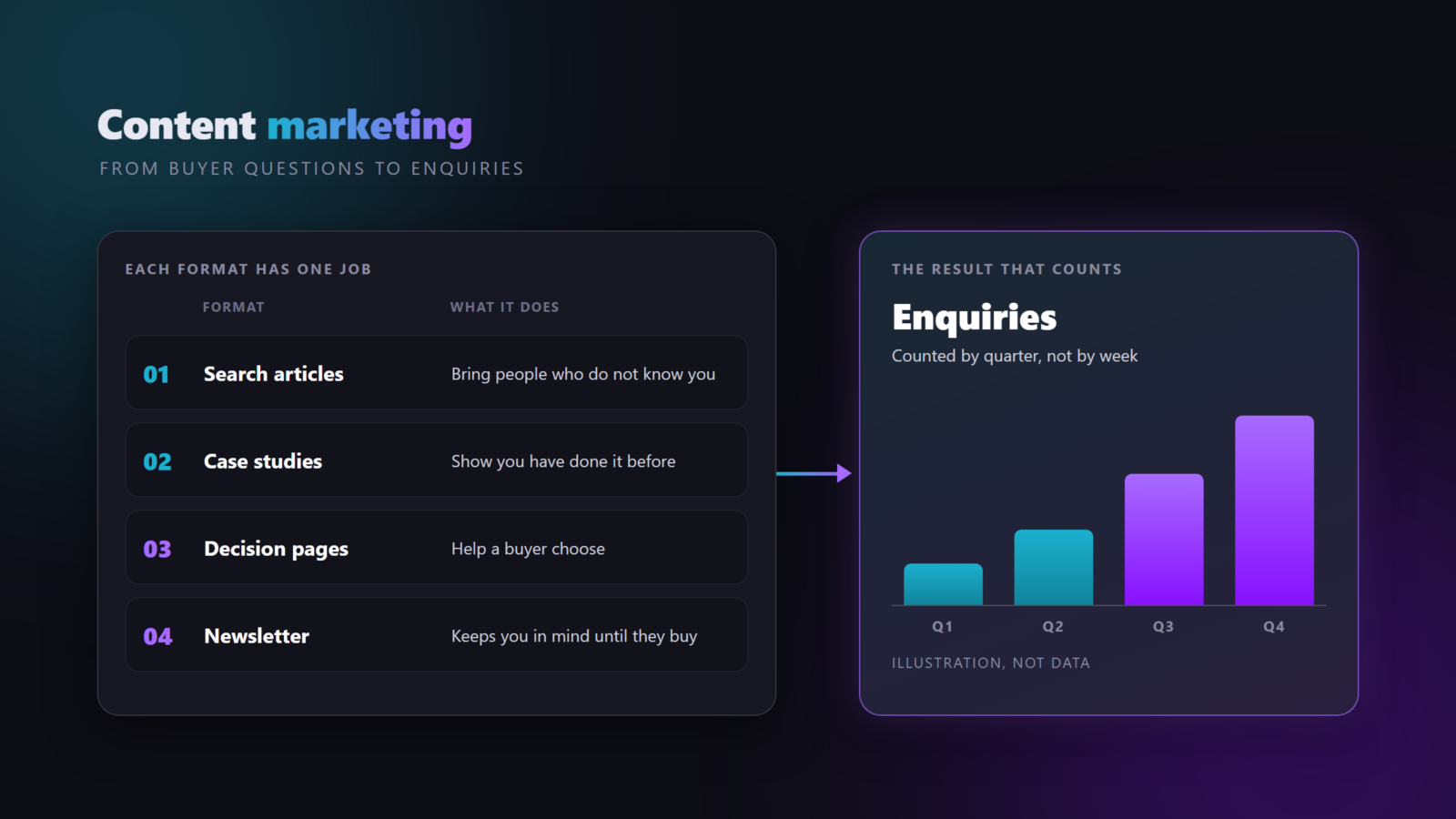
Articles that answer search questions bring in people who do not know you yet. They are where content overlaps with search, so each one needs a keyword with real demand behind it and a page that can compete, which is the work we describe in SEO as a marketing channel.
Case studies do a different job, since they are read by people who already know you and are deciding whether to trust you. One honest case study with a number in it, even an anonymised one, often does more for a sales conversation than ten general articles.
Then there are the pages that help a buyer choose: comparisons between approaches, explanations of what drives cost, and answers to the objections your sales team hears every week. They attract few visitors and a high share of serious ones.
A newsletter keeps you in front of people who are interested and not yet ready, which in a long sale is most of them. Original data comes last, because it takes the most effort, but it is what other sites cite, and being cited is how you earn backlinks worth having.
How often to publish, and what AI changes
Publish at the pace you can hold for a year without lowering the standard. We would start with two to four substantial pieces a month, though the number matters far less than whether each piece is the best answer available to its question.
Google’s guidance on creating helpful, people-first content, last updated in October 2026, treats volume as a warning sign. It asks whether you are producing lots of content on many different topics in hopes that some of it might perform well in search results, and it says plainly that Google has no preferred word count.
AI makes this more pressing. In the CMI survey, 88% of B2B marketers said their organisation uses AI-powered content creation tools, and when asked what generative AI contributes to their content, 78% chose speed while only 17% chose quality. Everyone can now publish more, so publishing more is no longer an advantage. Use AI to research, outline and edit, and keep what it cannot supply: what you have seen in your own projects, your numbers and your opinion.
Those are the parts readers came for.
How to measure content marketing by enquiries
Traffic is the wrong headline number, partly because it was always a means and partly because it has become unreliable. In the same survey, 31% of B2B marketers said organic traffic to their website rose over the last 12 months and 31% said it fell, and among those who saw it fall, 79% pointed to AI-powered search.
Measure what the business feels instead. Count the enquiries that began with an organic visit, and those where a piece of content was read along the way, even if another channel took the last click. Ask sales which pieces they send to prospects, because content that shortens a sales conversation is working even when it ranks for nothing. Check whether other sites and AI answers cite you.
Give it time as well. A new article usually needs months, not weeks, to settle in search, so judge the programme by quarters. And if visitors arrive and do not enquire, the problem is usually the page they land on, which is a job for conversion rate optimisation and not for more content.
Where to start if you have published little
Do not begin with a calendar of fifty topics. Begin with what you already know:
- Write down the ten questions your sales team answers most often. Those are your first ten pieces.
- Check which of them people search for and write those as articles. The rest become pages your team sends by email.
- Produce one case study with a real number in it, with the customer’s permission or anonymised.
- Make sure every piece leads somewhere: a service page, a contact form or a next article.
- After three months, look at which pieces brought enquiries and write more of that kind.
If you would rather not build this alone, our content marketing services cover the plan, the writing and the measurement. You can also tell us what you publish today and we will say where we think the enquiries are being lost.
FAQ
How long does content marketing take to work?
Expect the first signs within a few months and a dependable flow of enquiries later than that, since a new article usually needs time to settle in search and buyers in a long sale need time to decide. Case studies work sooner, because your team can send them to prospects the day they are published.
Is content marketing the same as SEO?
No, though they overlap. SEO makes pages findable in search, while content marketing is the wider practice of publishing useful material to win buyers, including formats that never rank, such as newsletters and case studies. Articles written to answer search questions belong to both, which is why the two are usually planned together.
Can AI write your content for you?
It can speed up research, outlines and editing, but it cannot supply what makes a piece worth reading: your experience, your data and your judgement. In CMI’s survey of B2B marketers, published in November 2026, 78% named speed as a contribution of AI to their content and 17% named quality. Keep a person responsible for every piece.
How much content does a small company need?
Less than most plans assume. A small company does well with a handful of strong pieces: answers to its buyers’ most common questions, one or two case studies and service pages that explain the offer clearly. Add more only at a pace you can sustain, since Google’s guidance treats publishing in volume for its own sake as a warning sign.
What determines the cost of content marketing?
Cost depends on how many pieces you publish, how much specialist knowledge each one needs, whether it includes original research, design or video, and who measures the results. A technical article reviewed by an engineer takes more to produce than a general one. Start from the enquiries you need and size the programme to that.