
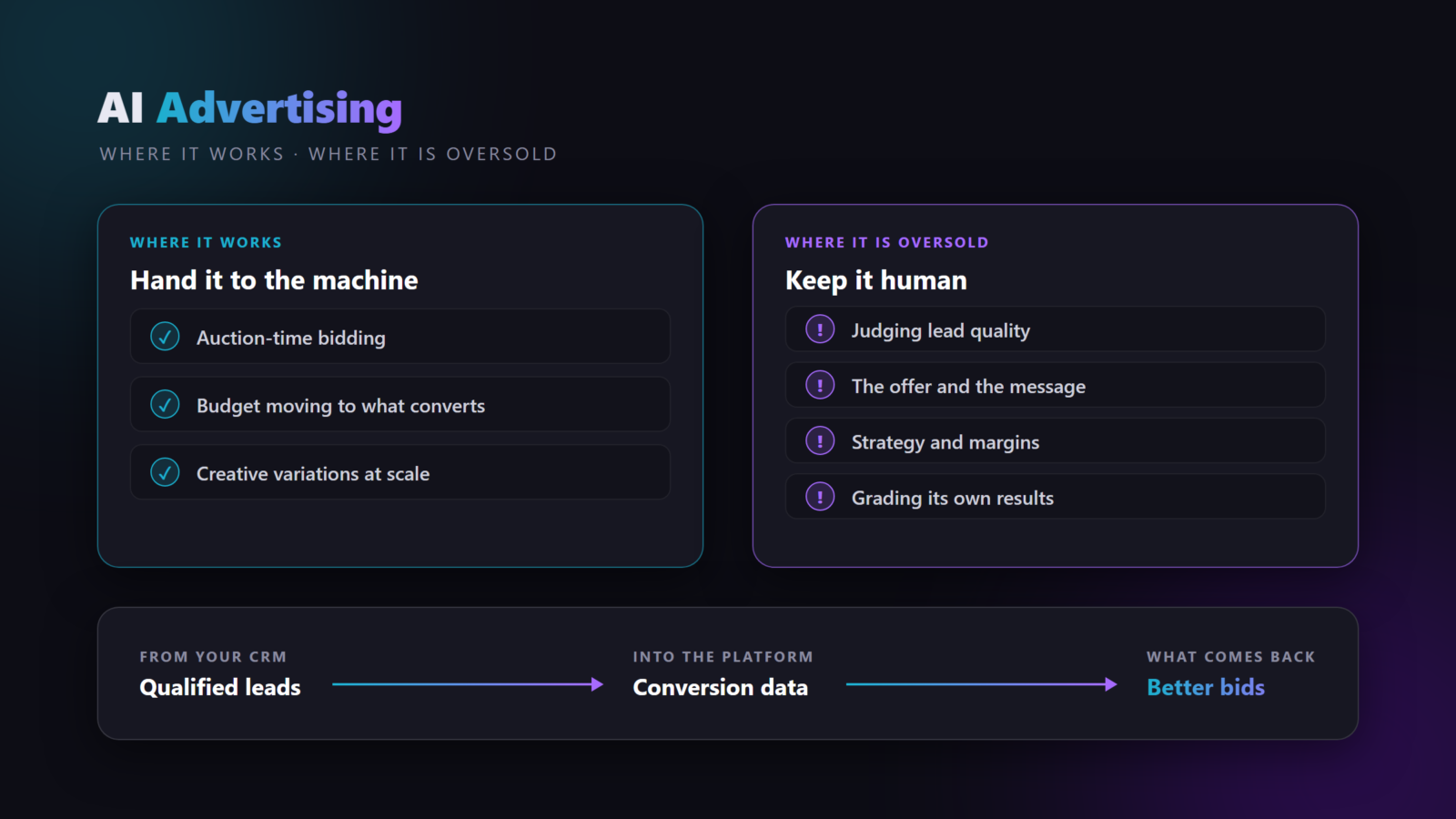
AI advertising, in practice, is mostly the machine learning built into Google Ads and Meta: it sets your bids, moves your budget and assembles your creative. It beats manual buying when it gets enough clean conversion data, and it is oversold when it is asked to judge lead quality it cannot see or to replace your strategy.
The term AI advertising is used loosely. It also covers the AI ad generators that fill much of the search results for the term and, since August 2026, ads inside ChatGPT, which OpenAI opened to 31 European markets and lists as available in Greece. The machine learning inside Google Ads and Meta is less exciting than either, though it is where your media budget already goes. So the useful question is not whether to use AI advertising, since you almost certainly do, but which decisions to hand over and what to feed the machine first.
The AI you are already paying for
If you run Google Ads with Target CPA, Maximize conversions or Target ROAS, you are using Smart Bidding, which Google Ads Help (fetched October 2026) describes as bid strategies that use Google AI to optimise for conversions or conversion value in every auction. Performance Max goes further and runs Search, YouTube, Display, Discover, Gmail and Maps from a single campaign, with Google deciding where each euro goes. On Facebook and Instagram, Meta’s ad delivery system does the same job inside Ads Manager.
Most advertisers are only partway there. The IAB (Interactive Advertising Bureau), the US trade body for digital advertising, surveyed more than 500 people across the buy and sell side for its State of Data 2025 report, published in March 2025. Only 30% of agencies, brands and publishers had fully integrated AI across the media campaign lifecycle.
Where AI genuinely beats manual buying
Bidding is the clearest win for AI advertising, because no person can weigh what the machine weighs at auction time. Google’s list of Smart Bidding signals includes device, physical location, location intent, weekday and time of day, remarketing lists, browser, operating system and the actual search query, all combined for each individual auction. A manual bid adjustment by device or hour is a rough average of what the algorithm prices one search at a time.
Budget allocation is the second. Performance Max, in Google’s own words, funnels budget toward the inventory and placements that perform best, which is the kind of shifting a media buyer does weekly and the machine does continuously.
Testing at scale is the third. Responsive ads and Performance Max asset groups combine your headlines, descriptions and images into versions no team would build by hand, then report which assets carry the weight. Broad match paired with Smart Bidding belongs here too, since it finds queries you would never have thought to list, provided the bidding knows what a good conversion looks like.
That proviso does most of the work.
The part nobody mentions: the data it needs
Every one of those wins depends on conversion data, and the platforms say fairly openly how much. Google’s Smart Bidding page recommends judging performance over periods with at least 30 conversions, or 50 for Target ROAS, and notes that some strategies rely on a minimum volume of historical conversion data depending on the campaign type. For lead generation it sets a separate bar: its best practices for high-quality leads ask that the conversion action you bid on has generated at least 15 conversions in the last 30 days at the account level, and that it ideally happens within 7 days of the ad interaction.
Meta’s Business Help Center says an ad set usually leaves its learning phase after about 50 results in the week after its last significant edit. During learning, Meta adds, performance is less stable and cost per result is usually higher, and every significant edit starts learning again.
Now picture a B2B account with 15 leads a month across five campaigns. The account only just reaches Google’s minimum and no campaign comes near the other thresholds, so the AI is guessing from a few data points and you are paying for its education. Before you switch on more automation, consolidate campaigns so the data pools in one place, stop editing every few days, and consider optimising to an earlier step that still signals real intent if your final conversion is too rare or arrives months after the click. A contract signed three months later comes too late to be much use to the bidding.
Where AI advertising is oversold
Lead quality is the big one. The algorithm buys more of whatever you count as a conversion, so if a form fill is the goal, it will find you the cheapest form fills it can, including the student, the competitor and the bot. Google’s own guidance on generating high-quality leads recommends bidding on qualified or converted leads rather than raw volume, and upgrading offline conversion imports to enhanced conversions for leads. If your cost per lead keeps falling while sales say the leads are getting worse, the machine is doing exactly what you asked. It is also worth checking where leads are lost before the form, because AI bidding cannot fix a page that does not convert.
AI-generated ads are the second. In the IAB’s study The AI Ad Gap Widens, published in January 2026, 83% of US ad executives said their company has deployed AI in the creative process, up from 60% in 2024. In the same study, 82% of them believed Gen Z and Millennial consumers feel positive about AI-generated ads, while only 45% of those consumers said they do. Generative AI is good at variations, formats and resizing, which saves real hours, but it multiplies a message rather than supplying one. An ad generator cannot tell you why a plant manager in Thessaloniki should switch suppliers.
In the EU there is now a legal side too. Article 50 of the AI Act has applied since 2 August 2026, and the European Commission’s guidance says that AI-generated or manipulated images, audio or video that resemble real people, objects, places or events and would falsely appear authentic must be clearly disclosed. If an image, voice or video in your ad was generated or altered with AI and could pass for a real person, place or event, check it with your lawyer before it runs.
Then there is “set and forget”. A platform that reports its own results, attributes its own conversions and recommends its own budget increases is grading its own homework, so the numbers in the dashboard are a starting point for your judgement, not a replacement for it.
Strategy is the last thing AI advertising does not do. Which customers you want, what you sell them, at what margin and in which markets are decisions the algorithm inherits from you.
What to give the machine in a B2B account
The IAB’s State of Data research found that nearly two-thirds of respondents cite the quality of the data being used and produced as a top barrier, and in ad accounts that is usually where the work is. In order:
- Define one conversion that means a real lead. A qualified enquiry, not every form submission and certainly not page views.
- Send the CRM’s verdict back. Import which leads became opportunities and customers through offline conversion import or enhanced conversions for leads, ideally daily, so bidding learns from outcomes.
- Run fewer, bigger campaigns. Pool the conversions so each campaign has enough data to learn from.
- Give it creative with something to say. A clear offer and a reason to choose you, which the AI can then vary.
- Keep a view outside the platform. Judge results measured against revenue, not platform-reported conversions, because that is the number your business runs on.
Where people still matter
Once the plumbing is right, AI advertising handles the auction better than any of us, and fighting that is a waste of budget. What it cannot do is decide what to sell, to whom, at what margin, which audiences to exclude, or when a sudden drop in cost per lead is good news rather than a sign that the form has filled up with spam. Those calls are still the job of whoever runs your performance marketing.
If you want to see where the AI in your own account is helping and where it is guessing, start with our AI and automation work and tell us what you are running today.
FAQ
Is AI advertising worth it for a small account?
Usually, yes, but only once the account can feed it. If your conversions are spread thinly across many campaigns, bidding algorithms learn slowly and spend more while they do. Consolidate campaigns, choose one conversion that matters and give the system a few stable weeks before you judge it against your manual results.
Will AI replace the people who run ad campaigns?
It replaces the bid-by-bid and placement-by-placement work, which it does better than people. It does not decide what you sell, which customers are worth paying for, what the offer says or whether a reported result reached your sales team. Those decisions still need someone who understands your business and its margins.
How much conversion data does AI bidding need?
Google recommends judging Smart Bidding over periods with at least 30 conversions, or 50 for Target ROAS. Meta says an ad set usually exits its learning phase after about 50 results in the week after its last significant edit. Below those levels, the system works from limited data and results swing more.
Can AI-generated ads perform as well as human-made ones?
They can for variations, formats and testing, because the machine produces and rotates far more versions than a team would. The weak point is the message itself. AI ad tools rearrange what you give them, so the offer, the proof and the reason to choose you still have to come from you.
How do you stop AI bidding from optimising for junk leads?
Stop counting every form fill as success. Set a qualified or converted lead as the goal, import outcomes from your CRM through offline conversion import or enhanced conversions for leads, and upload regularly. The bidding then learns which clicks became customers, rather than which clicks filled in a form most cheaply.