
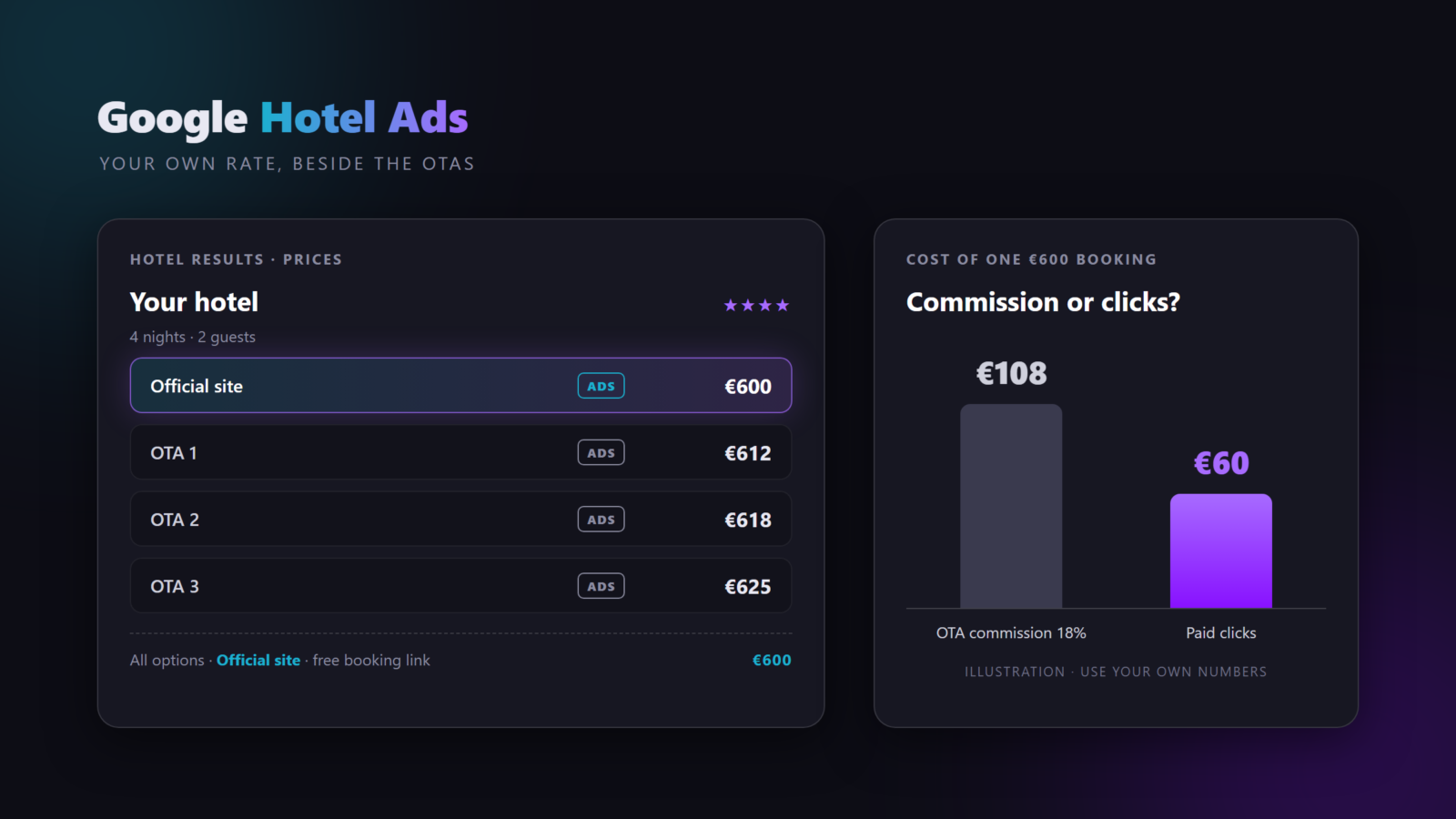
Google Hotel Ads are paid booking links that show your own room rate in Google’s hotel results on Search and Maps, right beside the OTAs, and send the guest to your booking engine. Free booking links appear in the same panel at no cost, so for most independent hotels the sensible order is free first, paid second.
Paid links earn their place only where your rate wins the comparison on the page and a booking costs you less in clicks than it would in commission.
How the hotel auction works
Everything starts in Google Hotel Center, which holds your property, an up-to-date set of prices for different itineraries, and the landing pages guests arrive on. A booking engine or channel manager acting as an integration partner usually sends all three to Google for you.
When a traveller opens your hotel on Google, they see a booking module with a list of prices. The paid links carry an “Ads” badge, and the free booking links sit under “All options”. According to Google, the paid ones are ranked in an auction that weighs each partner’s bid with the quality of the ad, and quality includes how accurate your prices are. A feed that shows €140 and then charges €165 at checkout costs you twice.
Google’s help page for hotel campaigns (fetched October 2026) lists commission per conversion, commission per stay for select partners, Target ROAS, a fixed or percentage max CPC, and enhanced CPC. The same page links to a notice that commission-based strategies are being sunset, so check what your own account offers before you plan around paying only for completed stays. Campaigns can target travellers by country of residence and device, with bid adjustments by itinerary, such as length of stay.
Start with the free booking links
Free booking links are easy to skip, which is a strange thing to leave on the table. They need the same Hotel Center feed as the paid campaign, they cost nothing per click, and they put your own rate in the list where guests are already comparing prices.
They also give you a cheap test. Run them for a few weeks and check whether your price sits above, level with or below the OTAs for the dates that matter. If your rate is regularly the highest in the panel, paying Google to show it more prominently will only make the gap more visible, so fix the rate first. It is also where our direct-booking work for hotels starts.
Where paid hotel ads beat the OTAs
The European Hotel Distribution Study 2026 by HOTREC, the European hospitality association, published in September 2026 and based on 2,713 hotels, found that in 2025, 51.3% of bookings came through hotels’ own channels and 29.9% through OTAs, up from 19.7% in 2013. The same study found that 83% of hotels with a metasearch connection use Google Hotel Ads.
The arithmetic is where the decision gets made. Take a four-night stay at €150 a night. On an OTA contract at 18%, which we use here only as an illustration, that €600 booking costs you €108. If your paid clicks cost €1.50 each and one in forty of them books, the same guest costs €60 through Google, and the email address, the pre-arrival message and the chance of a return visit remain yours. Swap in your own numbers, because the answer changes from one property to the next, and judge the channel the way any performance marketing measured against revenue should be judged.
Your own hotel name is the clearest case. People who search for it have already chosen you, yet the panel they see often lists several OTA prices for your rooms. A paid link on your own name is usually the cheapest guest you will ever pay for, because the alternative is paying the full commission on someone who was looking for you anyway.
Where they lose money
Paid hotel ads lose money when the price comparison is lost before the click. HOTREC’s 2026 study found that 51% of hotels report OTAs undercutting their prices frequently or occasionally, up from 43% in 2023, and four in five of those affected say they never agreed to the lower price. If an OTA shows your room for less than you do, your paid link sits beside a cheaper version of itself.
The booking engine is the second leak. A guest who meets a slow page or a payment step that fails on a phone goes back to the OTA, and you have paid for the visit. It is worth looking at where a booking form loses people before you buy more traffic for it.
Bidding hard on weeks you would sell out anyway buys bookings you already had.
What is different on a Greek results page
Hotel searches in Greece run on a different results page from the US screenshots in most guides. Greece sits in the European Economic Area, where Google Search Central, Google’s documentation for site owners (page updated October 2026), describes a separate layout for searches like “hotels near me”. An aggregator unit is filled by OTAs, metasearch sites and other intermediaries, and a separate supplier unit beside it gives visibility to direct providers. Check your own results page from Greece before judging how much room your listing has.
Seasonality shapes the rest. A property open from May to October needs its budget when its source markets book, which is often months before the first guest arrives. Because hotel campaigns target by the traveller’s country, you can follow each market’s booking calendar instead of switching everything on at once.
How to tell whether it is paying
Count each paid booking against the commission you did not pay, minus the ad cost and cancellations. Keep bookings on your own hotel name apart from bookings that came from searches for the destination, because the first group protects margin and the second one finds new guests, and they deserve different budgets.
Give it a full season before you decide, because a single month in a seasonal business tells you more about the calendar than about the channel. Our case study on direct bookings for a five-star hotel in Paros shows how it fits into a wider plan.
A sensible order to start
- Connect Hotel Center through your booking engine or channel manager and switch on the free booking links.
- Check your rate against the OTAs for your key dates, and correct parity problems before spending anything.
- Run a small paid campaign on your own hotel name and compare its cost per booking with your commission.
- Add campaigns for the destination searches, market by market, following when each country books.
- Review it after the season against the commission you saved, not against clicks.
Google Hotel Ads work best inside a plan that also covers your website, your rates and the rest of your performance marketing. If you want a second opinion on where your direct bookings leak, talk to our hotel marketing team.
FAQ
Is Google Hotel Ads free?
The free booking links are. They appear under “All options” in Google’s hotel results and cost nothing per click. The paid links, labelled “Ads”, are charged according to the bid strategy you choose. Both draw on the same Hotel Center feed, so once the free links work, adding the paid campaign is mostly a budget decision.
Do you need a booking engine to run Google Hotel Ads?
In practice, yes. Google needs live prices and availability for your rooms, and a landing page where the guest can book. Most hotels send these through a booking engine or channel manager that acts as an integration partner, which keeps rates in Hotel Center matched to what the guest sees after the click.
How much does Google Hotel Ads cost?
There is no fixed price. The media cost depends on the bid strategy, the markets you target, how many partners compete for your hotel and how good your price is. The useful question is the cost per booking, compared with the commission the same booking would cost through an OTA.
Can a small independent hotel compete with the OTAs on Google?
On its own name, usually yes, because guests searching for your hotel already want you and OTA prices for your rooms often appear beside them. On broad destination searches it is harder and depends on your rate and budget. Start where your advantage is clearest and widen only when the numbers hold.
What is the difference between Google Hotel Ads and free booking links?
Both show your rate in the same booking module. Paid links carry an “Ads” badge, appear in the main list of prices and are charged per click or by your chosen bid model. Free booking links sit under “All options”, cost nothing and give you less control over how visible your price is.