

The site

The live homepage, top to bottom · hover to pause
Two audiences, one homepage
A property manager's website is read by two very different people. A guest wants to know is it free on my dates, and is it as good as it looks. An owner wants to know can I trust these people with my house.
Most rental sites pick one and leave the other to a page nobody finds. This one gives each of them a clear road from the first screen. The availability search sits over the hero video, so a guest can check dates before they have scrolled at all. Further down, the homepage turns to the owner, with its own invitation to partner and its own page to read.
Both roads end in the same place: a conversation with the Elysian team. That is where a rental business actually wins its bookings and its new properties.
A guest is asking whether it is free on their dates. An owner is asking whether they can trust you with their house. The site has to answer both.
Built to make the phone ring
In this business the best leads still arrive by phone, so the site never makes anyone hunt for a number.
- At the top of every page: both direct lines and a Contact button in the header, before the visitor has scrolled at all.
- On the owners' page: the numbers again, placed straight after the service list, where an owner who has just read what is included decides whether to call.
- For owners who would rather not call yet: a request-a-callback form, so the first conversation happens at a time that suits them.
- On every villa page: dates, guests and price in one place, so an enquiry arrives already specific.
- In the footer: the numbers a final time, for the visitor who has read everything and is ready.
Every tel: link opens the dialler on a phone. On mobile, that takes one tap.
A villa on a phone
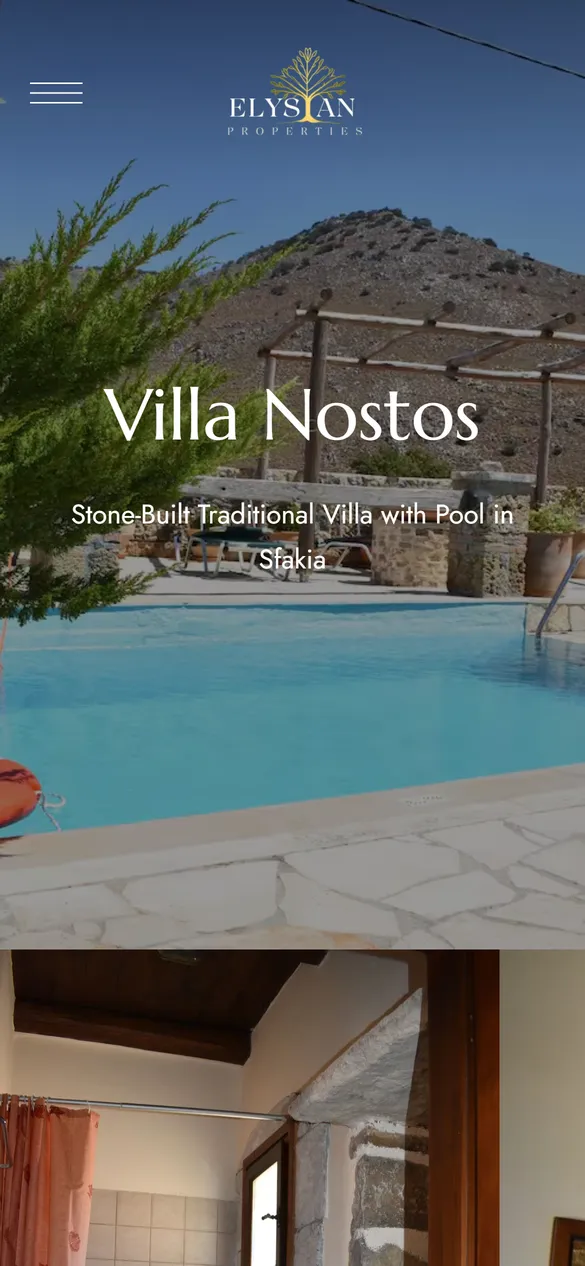
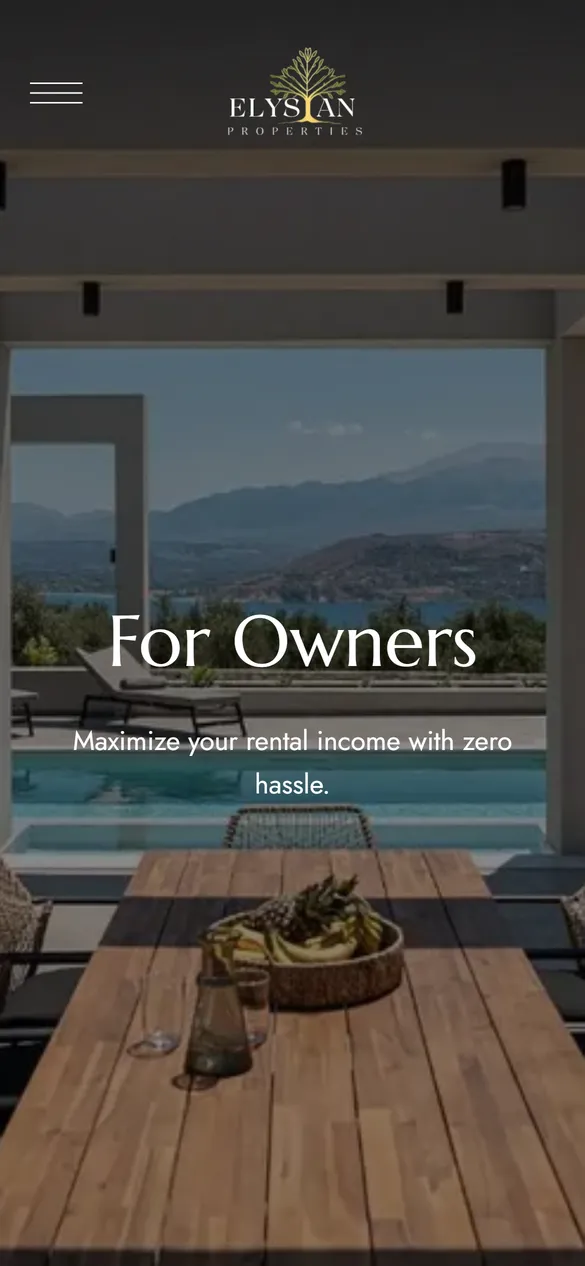
Most guests find a villa on their phone, often on a beach planning the next trip, so every house page was composed for a 390px screen first. The photography leads, the name and the one line that sells it sit on top, and booking is a short scroll away.
Connected to Hosthub
Elysian's homes are also listed on Airbnb and Booking.com, and run through Hosthub, the channel manager that keeps those calendars in step. The website is connected to the same source.
For the guest, the calendar they see on the site is the one that counts: a night booked on Airbnb is not offered again here. For the Elysian team, there is one calendar to manage, not three to reconcile by hand. A direct booking site is only worth having if people can trust its availability, and this one stays in step with the channels.
Fast, with a video hero
A homepage that opens on video is usually a slow homepage. This one shows its first content in about 1.1 seconds on desktop and fully loads in about 2, video hero, booking engine and photography included. On a phone, first content appeared in 1.1 to 2.1 seconds across the pages we tested.
For a rental site that matters twice over. Guests compare several tabs at once and close the slow ones, and an owner judging whether to trust you with their house reads speed as care.
Method: measured in headless Chrome on the live site, empty cache, unthrottled connection, 19 October 2026. Desktop homepage at a 1440px viewport, median of three runs; mobile at 390px on the homepage, the owners' page and a villa page. These are page timings, not Lighthouse scores — we would rather tell you exactly what was measured than quote a number whose method nobody states.
What we would tell another property manager
Your website is not competing with Airbnb for guests. Airbnb will always have more of them. It is competing to be the place where a returning guest books direct and a new owner calls you, and both of those are decided by how quickly the site earns trust.
Make it fast, keep the calendar honest, and never make anyone look for your number.
The services behind this project
The build and the booking setup were one job: a direct booking site only works if the engine underneath it is trusted.